








Before establishing a maintenance program, it is essential to understand how steel plank components degrade in field conditions:
Corrosion (at cut edges and damaged coating): Hot-dip galvanized coating provides excellent protection, but mechanical damage during handling, cutting, or welding can expose bare steel. Once the zinc layer is penetrated, corrosion initiates at the damage site and can spread under the adjacent coating (filiform corrosion). For steel plank units with localized red rust, early intervention can extend service life by 5–10 years.
Deformation from overload: Exceeding the uniformly distributed load rating (typically 200–270 kg for standard steel plank) causes permanent bowing. Even 5–10 mm of deflection compromises worker safety by creating trip hazards and reducing the effective platform width.
Weld degradation: Hook plates and anti-slip pattern welds are the most stressed areas. Fatigue cracking at weld toes is a known failure mode in steel plank units subjected to repeated loading cycles, particularly in high-traffic staging areas.
Connection wear: Hook plates that attach the steel plank to scaffold transoms experience wear at the contact surfaces. Excessive wear (exceeding 2 mm) allows the plank to shift under load, creating gaps and instability.
Daily Visual Inspection Protocol
Every steel plank should be visually inspected before each use. The inspection takes less than 30 seconds per unit and identifies the majority of safety-critical defects:
Check for corrosion: Look for red rust (indicating base steel exposure) rather than white rust (zinc oxidation, which is harmless). Surface rust at cut edges is common and manageable; penetrating rust on flat surfaces is cause for removal.
Check for deformation: Place the steel plank on a flat surface or sight along its length. Deflection exceeding 10 mm over the plank length is cause for rejection per most site safety standards.
Check hook plates: Verify that hook plates are securely welded, not bent, and that the retaining nuts (if present) are tight. Loose hook plates are a leading cause of steel plank dislodgement during use.
Check anti-slip surface: The pressed diamond or round-hole pattern should be clearly defined. If the pattern has been worn smooth or filled with concrete residue, the slip resistance is compromised.
Check for weld cracks: Run a wire brush over visible welds and look for crack initiation at the weld toe. Any visible crack is an immediate removal criterion.
Cleaning Protocols After Each Use
Concrete splatter, mortar, and chemical residues accelerate steel plank degradation if not removed promptly:
Concrete and mortar removal: Use a wire brush or low-pressure water jet (below 100 bar) to remove concrete residue. Avoid high-pressure water directly on galvanized surfaces, as it can erode the zinc coating. For stubborn deposits, a 5–10% hydrochloric acid solution can be used sparingly, followed by immediate fresh-water rinsing and drying.
Chemical residue removal: If the steel plank has been exposed to acids, alkalis, or salt solutions, rinse thoroughly with fresh water within 24 hours. Chemical residues that remain on the surface can penetrate microscopic coating defects and initiate under-film corrosion.
Oil and grease removal: Use a degreasing agent compatible with galvanized surfaces (avoid solvents containing chlorinated hydrocarbons). Oil buildup reduces the effectiveness of anti-slip patterns and creates a slip hazard for workers.
After cleaning, allow the steel plank to dry completely before storage. Trapped moisture between stacked planks is a common cause of white rust development.
Storage Best Practices
Proper storage is the single most effective measure for extending steel plank service life:
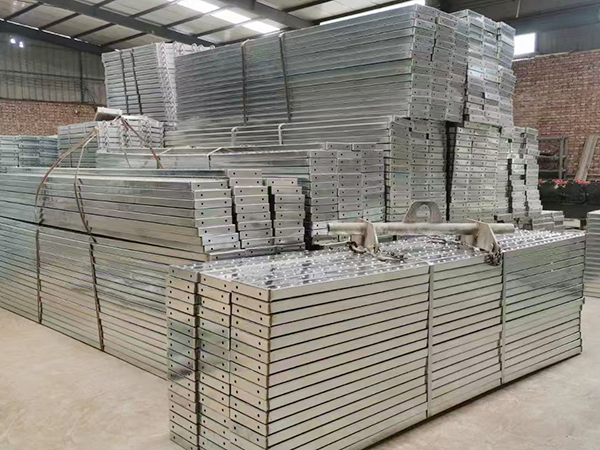
Elevated storage: Store planks on timber or steel bearers at least 150 mm above ground level. This prevents moisture absorption from the ground and allows air circulation beneath the stack.
Covered storage: Whenever possible, store steel plank units under a roof or tarpaulin. UV exposure does not damage galvanized coatings, but rain accumulation in stacked planks accelerates white rust formation on the zinc surface.
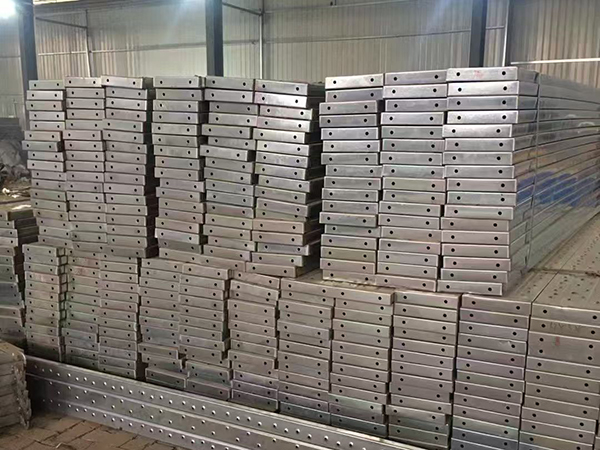
Ventilated stacking: Do not stack planks tightly together for long periods. Use spacers (timber battens) between layers to allow air circulation. This is particularly important in humid climates where condensation can form between adjacent planks.
First-in, first-out (FIFO): Implement a FIFO system to ensure even usage across the inventory. Planks that remain in storage for more than 12 months should be inspected before deployment, even if they appear unused.
Corrosion Protection and Repair
When the galvanized coating on a steel plank is damaged, prompt repair prevents corrosion from spreading:
Clean the damaged area: Remove all loose rust and contamination using a wire brush. The surface should be bright metal for a minimum of 10 mm around the damage site.
Apply zinc-rich paint: Use a cold-galvanizing compound containing at least 65% zinc dust by weight (dry film). Apply two coats, allowing proper drying time between coats. This provides sacrificial protection comparable to hot-dip galvanizing for small repair areas.
Document the repair: Mark repaired steel plank units with the repair date and location. Track repaired units separately and inspect them at twice the frequency of intact units.
For damage covering more than 10% of the plank surface area, or for structural deformation exceeding 10 mm deflection, replacement is more economical than repair.
Replacement Criteria: When to Remove a Steel Plank from Service
Objective, documented replacement criteria prevent subjective decision-making and ensure consistent safety standards across the inventory:
Deflection: Permanent bow exceeding 10 mm measured over the plank length.
Corrosion: Section loss exceeding 10% of original thickness (measure with ultrasonic thickness gauge), or any through-corrosion (perforation).
Hook plate damage: Cracked, bent, or detached hook plates. Any hook plate that shows visible cracking at the weld must trigger immediate removal.
Weld cracks: Any crack in the main body welds or hook plate welds, regardless of size.
Severe coating loss: Galvanized coating completely absent over more than 30% of the surface area, exposing bare steel across large regions.
Removed steel plank units should be physically destroyed or clearly marked with indelible "SCRAP" markings to prevent accidental redeployment.
Maintenance Records and Asset Tracking
For organizations managing inventories of 200+ steel plank units, a documented tracking system is essential:
Unique identification: Stamp or engrave a unique ID on each plank (e.g., SP-001, SP-002). This enables tracking of inspection dates, repair history, and service life per unit.
Inspection log: Maintain a record for each plank with inspection dates, inspector name, pass/fail determination, and any noted defects. Digital inspection apps significantly reduce administrative burden compared to paper logs.
Maintenance schedule: Schedule heavy maintenance (detailed inspection, cleaning, coating repair) at least annually for active inventories, and every 2 years for reserve inventories.
FAQ: Steel Plank Maintenance
How often should steel plank be inspected?
Visual inspection before each use is mandatory. Detailed documented inspection should occur at least every 6 months for active inventories and annually for reserve stocks. In corrosive environments (marine, chemical plants), inspections should be conducted every 3 months.
Can damaged galvanized coating be repaired on-site?
Yes. Clean the damaged area to bright metal and apply a zinc-rich cold-galvanizing compound containing at least 65% zinc dust. This provides sacrificial protection. However, repairs covering more than 10% of the surface area warrant consideration of replacement rather than repair.
What is the expected service life of a properly maintained steel plank?
Hot-dip galvanized steel plank with proper maintenance typically delivers 15–25 years of service. In low-corrosion environments, service life can extend beyond 30 years. The key factors are prompt repair of coating damage, proper storage, and adherence to load limits.
Is white rust on steel plank a problem?
White rust (zinc oxide/hydroxide) forms on galvanized surfaces exposed to moisture and poor air circulation. It is not structurally significant and can be removed with a wire brush. However, heavy white rust indicates poor storage conditions that should be corrected to prevent progression to red rust (base steel corrosion).
Conclusion
Maintaining steel plank for long-term use is not complex, but it does require discipline: daily visual inspection, prompt cleaning after use, proper storage, and systematic documentation. Organizations that implement these practices consistently achieve 15–25 year service life from their steel plank inventories, while those that neglect maintenance frequently replace planks every 5–8 years—a false economy that adds substantial unnecessary cost.
For procurement and site management teams, the maintenance program should be viewed as an asset protection strategy. The incremental cost of inspections, cleaning, and minor repairs is typically 3–5% of the plank replacement cost per year, compared to 15–20% if planks must be replaced every 5–8 years due to neglect.
References
British Standards Institution. (2019). BS EN 12811-1:2019 Temporary Works Equipment—Scaffolds—Performance Requirements and General Design. BSI.
International Organization for Standardization. (2019). ISO 1461:2019 Hot Dip Galvanized Coatings on Iron and Steel Articles. ISO.
American Galvanizers Association. (2022). Maintenance and Repair of Hot-Dip Galvanized Steel. AGA Technical Notes.
Zhang, L., & Wang, H. (2020). "Corrosion Performance of Repaired Galvanized Coatings in Industrial Atmospheres." Corrosion Science, 167, 108512.
Health and Safety Executive. (2023). Scaffold Inspection and Maintenance Guidelines. HSE Books.