








The performance of a steel support system on a construction site depends entirely on decisions made weeks earlier inside a manufacturing facility. The quality of the raw steel, the precision of the forming process, the consistency of the welding, and the thoroughness of the inspection—each step in the production chain determines whether the steel support will perform reliably under load or fail prematurely. For procurement teams evaluating steel support suppliers, understanding what happens inside a reputable factory is essential for distinguishing quality products from budget alternatives.
This article takes an inside look at the manufacturing and quality control process that produces dependable steel support products, based on established practices in the forming and fabrication industry.

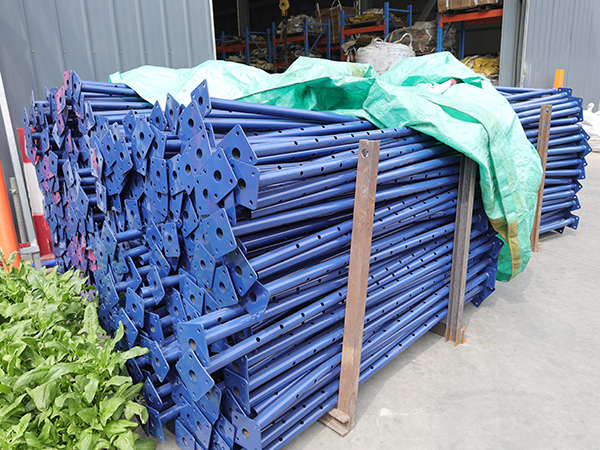
Raw Material Selection and Mill Certification
The manufacturing of a steel support prop begins not at the factory, but at the steel mill. The raw material—typically S235 or S355 structural steel in tube, pipe, or plate form—carries specific mechanical properties that must be confirmed before fabrication begins. A quality manufacturer sources steel with mill test certificates (MTCs) that document the chemical composition and mechanical properties of each delivery batch.
Key properties verified at this stage include:
Yield strength: Confirms the steel meets the minimum specification for the prop design (typically 235 MPa for standard props, 355 MPa for heavy-duty steel support units).
Carbon equivalent value (CEV): Indicates weldability. A CEV above 0.45% increases the risk of hydrogen cracking in welds and requires special preheating procedures at the factory.
Dimensional tolerances: The outer diameter and wall thickness of the tube sections must fall within the tolerances specified in EN 10219 or equivalent standards. Steel that is out of tolerance will produce props with inconsistent load capacity.
A reliable supplier will make these MTCs available to procurement teams upon request. If a manufacturer cannot provide traceable material documentation for their steel support products, there is no way to verify that the raw material meets the required specification.
Tube Cutting and End Preparation
Once the raw steel tube is received and verified at the factory, the manufacturing process begins with cutting the tube to length. The outer tube (the fixed section) and the inner tube (the sliding section) of a telescopic steel support prop are cut to precise lengths to achieve the specified closed and extended heights.
The end preparation step is important for both safety and function. The base plate and head plate are cut and drilled to receive the prop tubes. The quality of the end preparation directly affects:
The perpendicularity of the prop—a poorly prepared end will cause the steel support to lean under load, reducing its effective load capacity.
The fit of the base and head plates—loose-fitting plates will rattle during handling and may shift under load.
The quality of the weld joint—inconsistent end preparation leads to inconsistent weld penetration.
Welding: The Critical Quality Step
Welding is the single most quality-sensitive step in steel support manufacturing. The welds that attach the base plate and head plate to the tube sections carry the entire working load of the prop. A defective weld can reduce the prop's load capacity by 50% or more—even if every other component is within specification.
A competent manufacturer uses documented welding procedures (WPS—Welding Procedure Specification) that define:
Welding process: MAG (Metal Active Gas) welding is the industry standard for steel support production, using a shielding gas mixture of argon and CO₂.
Weld parameters: Current, voltage, travel speed, and wire feed rate are specified for each weld type and material thickness. A factory with good process control monitors these parameters throughout the production run.
Weld inspection: Visual inspection of every steel support weld is the minimum requirement. For heavy-duty props, non-destructive testing (magnetic particle or dye penetrant) of a statistical sample from each batch provides additional quality assurance.
The welder qualification is another aspect that distinguishes a serious manufacturer from a low-cost supplier. Welds on steel support products should be produced by welders certified to EN 287-1 or ISO 9606-1. If the manufacturer cannot confirm welder certifications, the weld quality on the props cannot be relied upon for structural applications.
Hot-Dip Galvanization Process
After welding and inspection, the steel support components move to the galvanizing facility. Hot-dip galvanization to ISO 1461 is the standard corrosion protection for adjustable steel props, and the process involves several controlled stages:
Degreasing: Oil and grease are removed in a hot alkaline solution.
Pickling: Mill scale and rust are removed by immersion in dilute hydrochloric acid.
Fluxing: A zinc ammonium chloride flux is applied to prepare the steel surface for reaction with molten zinc.
Galvanizing: The components are immersed in molten zinc at approximately 450°C. The zinc reacts with the steel surface to form a series of zinc-iron alloy layers topped with a pure zinc outer layer.
Inspection: Coating thickness is measured using a magnetic thickness gauge. ISO 1461 requires minimum coating thickness based on the steel section thickness. For the tube sections typical of a steel support, this is typically 55–85 µm.
One issue that arises during galvanizing is thread protection. The threaded collar mechanism of an adjustable steel support must remain functional after galvanizing. A skilled manufacturer masks or machines the threads after galvanizing to ensure smooth adjustment. Unprotected threads that are galvanized will have excess zinc that jams the collar mechanism.
Assembly and Functional Testing
After galvanizing, the steel support components are assembled: the inner tube slides into the outer tube, the collar mechanism is fitted, and the locking pin or bolt is installed. Each assembled unit should be functionally tested at the factory:
Height adjustment range check: Confirm the steel support achieves the specified closed and extended heights.
Collar operation test: The threaded collar or pin mechanism should operate smoothly throughout the full adjustment range without binding.
Proof load test: For critical applications, a sample of props from each batch is loaded to 1.5x the SWL and checked for permanent deformation.
Factory Quality Control Documentation
A quality manufacturer maintains documentation for every production batch of steel support products. These records include:
Raw material mill test certificates
Welding procedure specifications and welder qualifications
Galvanization coating thickness test results
Dimensional inspection records
Proof load test certificates (where applicable)
Batch number linking each steel support to its production records
FAQ: Steel Support Manufacturing and Quality Control
How can I verify the quality of steel support props before placing a bulk order?
Request a pre-production sample from the supplier and inspect it thoroughly. Check the weld quality for uniform bead appearance and full penetration. Test the collar mechanism for smooth operation. Measure the wall thickness of the inner and outer tubes with a caliper. If the sample steel support does not meet expectations, the production batch will likely be worse.
What is the most common quality defect in steel support manufacturing?
Weld defects around the base plate and head plate are the most frequently observed quality issues across factories producing steel support products. Porosity (small gas pockets trapped in the weld metal), lack of fusion (the weld metal does not bond fully to the tube wall), and undercut (a groove melted into the tube wall adjacent to the weld) are the defects most commonly identified during factory inspection.
Does galvanization hide existing weld defects in steel supports?
Yes—this is an important point for procurement. Hot-dip galvanization applies a thick, bright coating that can conceal surface weld imperfections. A quality manufacturer performs weld inspection before sending components for galvanizing. When evaluating a supplier, ask whether weld inspection is performed before or after galvanization. Pre-galvanizing inspection is the correct practice.
Conclusion
The manufacturing and quality control process for steel support products involves multiple critical steps: raw material verification, precision cutting, certified welding, controlled galvanization, and functional testing. Each step determines the final quality of the product. Procurement teams that understand these processes are better equipped to evaluate suppliers, request appropriate documentation, and distinguish between a manufacturer that takes quality seriously and one that simply assembles components with minimal oversight. A well-manufactured steel support prop from a factory with documented quality procedures will outperform a cheaper alternative across hundreds of deployment cycles—delivering better safety, reliability, and total value.
References
British Standards Institution. BS EN 1065:2018 Adjustable Telescopic Steel Props—Product Specifications and Test Methods. BSI.
International Organization for Standardization. ISO 1461:2019 Hot Dip Galvanized Coatings on Iron and Steel Articles. ISO.
International Organization for Standardization. ISO 9606-1:2012 Qualification Testing of Welders—Fusion Welding. ISO.
American Welding Society. AWS D1.1:2020 Structural Welding Code—Steel. AWS.
European Committee for Iron and Steel Standardization. EN 10219-1:2006 Cold Formed Welded Structural Hollow Sections. CEN.