








Choosing between Steel Support and Aluminum Support is rarely as simple as comparing price lists. After years running falsework and propping packages on commercial and industrial sites, I have watched both materials get matched to the wrong job. Here are the practical differences, so choose with confidence at the next tender.
Why This Comparison Matters on Site
Temporary support is where safety margins are thinnest. A telescopic prop carries loads estimated in the design office, yet crews manhandle it against the clock. The material choice drives two things at once: the safety factor available to the engineer and the physical effort demanded from the crew. When a system is too heavy, crews improvise lifting methods; when it is too light, it gets overloaded. Understanding what Steel Support and Aluminum Support each offer is a site-safety issue, not a procurement nicety.
Strength and Structural Capacity
Start with yield strength. Structural steel in common support grades, typically S355, offers a nominal yield of 355 MPa; 6061-T6, the common structural aluminum alloy, yields around 270 MPa. Steel's modulus of elasticity is roughly 200 GPa against aluminum's 69 GPa, so it resists bending and buckling about three times better for the same section. In compression, that is decisive: an aluminum column needs a larger diameter and thicker wall to match the steel prop's safe working load. Steel Support reaches higher safe working loads in compact formats, while Aluminum Support needs extra section size to close the gap.
Weight and Crew Handling
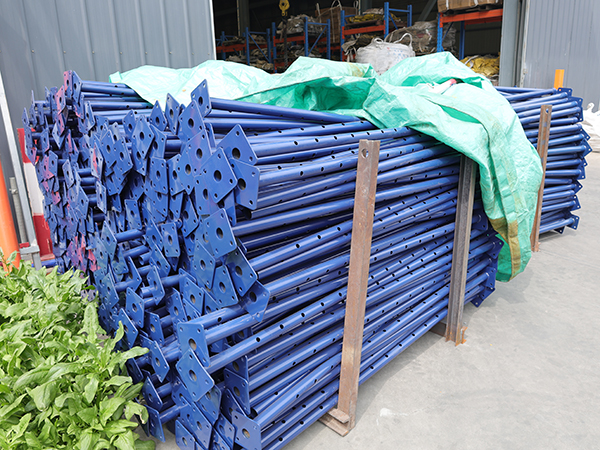
Here aluminum wins. Steel weighs about 7,850 kg per cubic metre against aluminum's 2,700 kg — roughly one-third of the mass for typical propping sections. A common steel telescopic prop in the 3.5 m range weighs 13 to 15 kg depending on wall thickness; an aluminum equivalent is typically 6 to 8 kg. When crews shift hundreds of props per floor per day, that difference is not a detail — fatigue injuries and slower erection cycles are weight-driven. That is why many contractors standardize on Aluminum Support for high-rise slab repetition, where handling speed sets cycle time. The trade-off: lighter sections dent more readily than steel when dropped on a congested deck.

Real-World Durability and Corrosion
Site conditions decide how long a system lasts. Hot-dip galvanized Steel Support handles daily abrasion well; the zinc layer sacrifices itself to protect the base steel. But once the galvanizing is scratched through — and on a busy site it will be — rust begins, especially in coastal regions or where chlorides sit against the legs. Aluminum forms a thin, self-healing oxide layer that halts corrosion in most atmospheres, which is why Aluminum Support is favored for marine and coastal work. The catch is galvanic corrosion: where aluminum contacts steel with moisture present, a bimetallic cell forms and eats the aluminum. Isolation pads and compatible fittings are not optional when mixing systems.
Lifecycle Cost Breakdown
Look beyond the purchase order. Steel Support carries the lower initial price — typically 30 to 40 percent less per unit than an equivalent aluminum prop — and galvanized steel, properly maintained, serves for many years. The lifecycle picture changes once maintenance and handling are counted. Steel needs periodic galvanizing inspection, touch-up painting where damaged, and derating once pitting develops. Aluminum needs little beyond cleaning, though badly dented sections should be retired. Add labor: handling time saved across a large repetitive package often offsets aluminum's higher purchase cost within a single project. The honest summary: Steel Support wins on unit economics; Aluminum Support usually wins on total project cost when labor and cycle time are priced in.
Application Decision Guide
The decision falls into recognizable patterns. Choose Steel Support for heavy concentrated loads — transfer beams, deep haunches, bridge falsework — where a compact high-capacity section saves headroom and mechanical handling is available. Steel also suits long hire periods, with lower rental rates and toughness for rough handling. Choose Aluminum Support for repetitive flat-slab propping, restricted access where every kilogram is carried by hand, and refurbishment jobs where heavy plant is banned. Aluminum also suits marine and humid environments where corrosion resistance outranks price. Many mature contractors run both fleets: steel for heavy work, aluminum for speed-critical repetition. The real mistake is not choosing steel over aluminum — it is choosing either without checking the load table, the access plan, and the maintenance regime.
FAQ
Is aluminum as strong as steel for support props?
Not directly. The 6061-T6 alloy yields around 270 MPa versus 355 MPa for S355 steel, and its lower stiffness demands larger sections. An aluminum prop can reach the same safe working load, but only with a bigger diameter and heavier wall — verify against the manufacturer's load tables.
Does an aluminum support system corrode on site?
Aluminum forms a self-protecting oxide layer and generally outlasts steel in coastal and humid conditions. The main risk is galvanic corrosion where aluminum touches steel with moisture present, so use compatible connectors and isolation wherever the metals meet.
Why are steel props cheaper to hire than aluminum ones?
Lower material cost and established manufacturing volumes keep steel unit prices down, and rental rates follow. That saving can disappear if slower handling extends your erection program, so compare total job cost, not the line item.
Can I mix steel and aluminum components in one system?
Mechanically yes, but manage the contact points. Where the metals touch with moisture present, galvanic corrosion attacks the aluminum. Use manufacturer interface components or isolation pads, and keep both systems within rated loads.
Conclusion
There is no universally superior material — only correctly and incorrectly specified systems. Steel Support remains the workhorse for heavy loads and long hire periods, while Aluminum Support earns its premium where handling speed, restricted access, and corrosion resistance decide the program. The teams that get this right read the load tables, walk the site, and price the full lifecycle. Match the material to the load, the access, and the environment, and either system performs; get that match wrong, and no specification sheet will save you.
References
Beale, R. G. (2014). Falsework and temporary works: the engineer's perspective. Structural Engineering, 92(6).
Godley, M. H. R., & Beale, R. G. (2001). Study of the behaviour of proprietary temporary falsework systems. Proceedings of the Institution of Civil Engineers - Structures and Buildings, 146(3), 277-287.
Peng, J. L., Pan, A. D., & Chen, W. F. (1996). Approximate method for the analysis of high clearance scaffold systems. Structural Engineering Review, 8(1), 55-66.
Zhang, H., Rasmussen, K. J. R., & Ellobody, E. (2012). Numerical modelling of steel storage rack uprights under compression. Journal of Constructional Steel Research, 75, 35-44.