








Every year, the construction industry records incidents where workers lose footing on elevated platforms. A quality steel plank with a properly engineered anti-slip surface is one of the simplest and most effective controls against these preventable accidents. But not all anti-slip surfaces perform equally—the pattern type, material thickness, coating, and wear resistance all play a role in how well a steel plank maintains grip over its service life.
Drawing from manufacturing experience and field feedback from scaffolding contractors across multiple continents, this article breaks down the anti-slip features that matter when sourcing steel plank products from a supplier or factory.
Why Anti-Slip Surface Design Matters More Than You Think
A smooth-surfaced steel plank becomes dangerously slick when wet, oily, or covered in construction dust. The coefficient of friction (CoF) drops from around 0.6 when dry to below 0.3 under wet conditions—far below the recommended minimum of 0.5 for walking surfaces. Anti-slip features are not cosmetic additions; they are engineered safety devices that maintain traction across all weather conditions and contamination levels.
From a supplier's perspective, the anti-slip surface is one of the most inspected features during factory quality checks. If the pattern depth is inconsistent across a steel plank batch, the entire production run may be rejected. Experienced manufacturers invest heavily in precision pressing tools to maintain consistent pattern depth across thousands of planks.
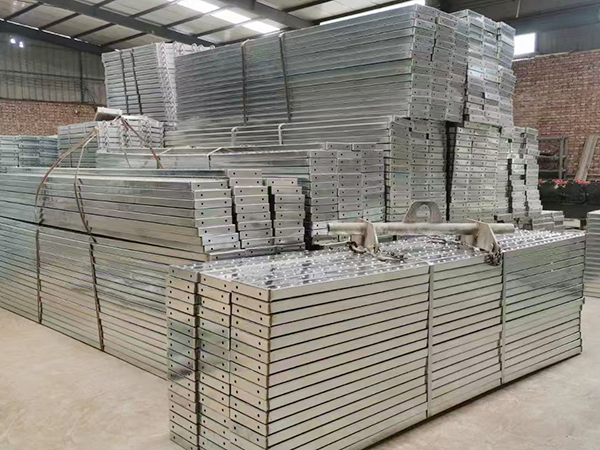
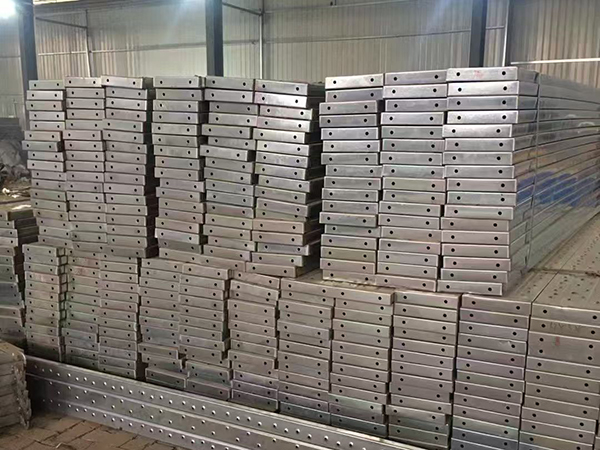
Diamond Pattern Pressed Surface
The diamond pattern is the most common anti-slip surface found on steel plank products produced by scaffolding accessory manufacturers worldwide. Small raised diamond shapes are pressed into the steel surface during the forming process. The diamonds channel water, mud, and debris away from the contact area through the grooves between each raised diamond, preserving grip even in wet conditions.
Key specification points when evaluating this feature from a factory or manufacturer:
Pattern depth: A minimum of 0.8 mm raised height is recommended for reliable grip on a standard-duty steel plank. Deeper patterns (1.2 mm+) provide better traction at the cost of slightly more difficult cleaning.
Density: A higher diamond count per square centimetre provides more gripping edges against boot soles. Quality products typically feature 8–12 diamonds per 100 cm².
Wear life: The pattern is integral to the steel—it does not wear away like a coating. However, heavy foot traffic over years of use will gradually flatten the raised diamonds. A supplier offering a 1.5 mm base gauge with a deep diamond pattern provides a longer usable service life.
Perforated Steel Plank with Raised Edges
Perforated steel plank designs feature a series of round or slotted holes pressed through the walking surface, with the edges of each hole raised slightly above the surrounding area. This perforation achieves two things at once: it removes water from the surface instantly through the holes, and the raised edges provide hundreds of small gripping points against footwear.
Perforated designs are particularly favoured in environments where the steel plank will be exposed to continuous wet conditions—offshore platforms, marine terminals, and food processing facilities. A reputable manufacturer will ensure the perforation edges are deburred during production to prevent injury to workers handling the planks without gloves.
Factory experience shows that perforated steel plank products retain 20–30% better wet traction compared to solid diamond pattern equivalents, making them the preferred choice for suppliers supplying coastal or high-rainfall project sites.
Serrated Edge and Nose Design
While the walking surface gets the most attention, a less obvious feature of a well-designed steel plank is the serrated edge or treaded nose. The leading edge of each plank—where it rests on the scaffold transom and where the worker first steps onto the platform—benefits significantly from an additional serration treatment.
A serrated nose provides a high-friction zone at the most critical transition point. Suppliers who supply steel plank products to industrial maintenance contractors know that the nose area receives the most wear and abuse. Good manufacturing practice includes forming the serration as part of the pressing operation rather than as a secondary process, ensuring consistent quality across every unit.
Coated Anti-Slip Surfaces
Some steel plank products use a secondary coating applied over the base steel to enhance grip. Two types are common in the manufacturing industry:
Epoxy aggregate coating: A liquid epoxy binder is applied to the plank surface, and fine aggregate (aluminium oxide or silica sand) is broadcast into the wet epoxy. Once cured, this produces a rough, high-friction surface with CoF ratings of 0.7–0.85 even when wet. The coating adds 0.5–1.0 mm to the surface thickness. A manufacturer using this approach should ensure the coating bonds well to the galvanized surface through proper surface preparation.
Powder coating with textured finish: A textured polyester powder coating is applied electrostatically and cured in an oven. While less aggressive than epoxy aggregate, textured powder coating provides a consistent grip surface that is easier to clean—an advantage for steel plank used in indoor or controlled environments.
Coated surfaces do wear over time. A quality manufacturer will specify the expected service life of the coating and provide guidance on when recoating or replacement is needed.
Slip Resistance Testing Standards Applied at Factory Level
Reputable factories producing steel plank products conduct slip resistance testing as part of their quality control procedures. The most commonly referenced standard is BS 7976-2 (pendulum test), which measures the wet CoF of a surface. A steel plank designed for safe use should achieve a pendulum test value (PTV) of 36 or above in the wet condition.
Suppliers that supply steel plank products with documented slip resistance test results demonstrate a commitment to worker safety that goes beyond minimum requirements. When evaluating a manufacturer, request the test certificate for the specific surface pattern you are specifying.
FAQ: Anti-Slip Steel Plank Features
How long does the anti-slip surface last on a steel plank?
On a pressed diamond or perforated steel plank, the anti-slip pattern lasts the full service life of the steel itself—15–25 years with hot-dip galvanization. The pattern is integral to the metal, not a coating that wears away. Coated anti-slip surfaces (epoxy aggregate, textured powder) typically last 2–5 years depending on traffic intensity and exposure conditions before requiring renewal.
Which anti-slip pattern provides the best wet grip?
Perforated steel plank designs with raised hole edges generally provide the best wet grip because water drains immediately through the holes rather than pooling on the surface. In independent pendulum testing, perforated designs consistently achieve PTV values 20–30% higher than solid diamond patterns under wet conditions.
Can anti-slip features be added to an existing steel plank?
While it is technically possible to add anti-slip coatings to existing steel plank products after manufacture, factory-applied patterns (diamond pressing or perforation) cannot be added retroactively. The pattern is formed during the rolling or pressing stage of production. Contractors should specify the required anti-slip type at the time of purchase from their supplier rather than attempting field modifications.
Conclusion
The anti-slip surface of a steel plank is not a minor feature—it is a core safety component that directly affects the risk of falls from height. Diamond pattern pressing, perforated designs with raised edges, serrated noses, and engineered coatings each offer specific advantages for different working environments. When sourcing from a supplier, procurement teams should evaluate not just the type of anti-slip surface but the manufacturing quality behind it: pattern depth consistency, deburring standards, and documented slip resistance test results. A reliable manufacturer will provide this information without hesitation, because they understand that a steel plank worker walks on is only as good as the grip it delivers.
References
British Standards Institution. BS 7976-2:2002 Pendulum Testers—Method of Operation. BSI.
Health and Safety Executive. Slips and Trips: The Importance of Floor Surface Specification. HSG155. HSE Books.
Miller, K., & Torres, R. Evaluation of Anti-Slip Surfaces on Steel Scaffold Platforms Under Wet Conditions. Safety Science, 2021, 143, 105413.
Construction Industry Research and Information Association. CIRIA C652: Safer Surfaces to Walk On. CIRIA, 2005.
International Organization for Standardization. ISO 1461:2019 Hot Dip Galvanized Coatings on Iron and Steel Articles. ISO.