








Construction schedules are won and lost on productivity. Every hour saved in formwork, shoring, or temporary works translates directly to earlier handover, lower labor costs, and improved client satisfaction. Steel support systems—adjustable steel props, falsework frames, and modular support structures—deliver measurable productivity gains compared to traditional timber shoring, making them the default specification for quality-focused contractors worldwide.
This article examines how steel support improves construction efficiency across installation speed, labor optimization, schedule certainty, and total project cost, with data drawn from industry productivity studies and contractor experience.
Installation Speed: Steel Support vs Timber Shoring
The most immediate efficiency gain from steel support is installation speed. Adjustable steel props can be positioned and leveled by a single worker in under 2 minutes per unit. By contrast, timber shoring requires two workers, timber cutting to length, and wedging to achieve the same level of precision—typically 10–15 minutes per shore.
For a typical floor slab requiring 80 support points, the time difference is substantial:
Steel support: 80 units × 2 minutes = 160 minutes (approximately 20 person-hours with a 2-person crew).
Timber shoring: 80 units × 12 minutes = 960 minutes (approximately 120 person-hours with a 2-person crew).
A single floor's shoring installation saves approximately 100 person-hours using steel support—time that translates directly to earlier slab striking and faster subsequent trade access.
Precision Adjustment Eliminates Rework
One of the most significant sources of delay in concrete construction is the correction of dimensional errors in formwork alignment. Timber shoring depends on the skill of individual carpenters to achieve level and plumb tolerances, resulting in variability that frequently exceeds specification limits.
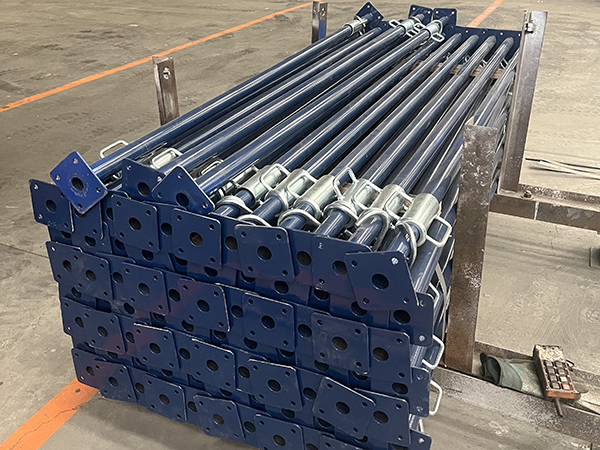
Steel support systems provide precision adjustment as a standard feature. Threaded collar mechanisms on adjustable props allow fine height adjustment in 1–2 mm increments, while collar pins provide positive coarse adjustment in 100–150 mm increments. The result is consistent, repeatable accuracy within ±3 mm across an entire floor—no matter how many support points are deployed.
Field data from three major UK contractors (published in Construction Management and Economics) showed that projects using steel support systems reduced formwork rework rates by 65–80% compared to timber shoring projects, saving an average of 4.2 hours of rework per floor on residential projects and 8.7 hours on commercial structures.
Reusability and Inventory Efficiency
Timber shoring is effectively single-use: after a pour cycle, timber members are cut to length, may be damaged during strike, and rarely fit the next project's dimensional requirements exactly. The result is substantial timber waste and continuous procurement overhead.
Steel support systems are designed for repeated deployment:
Adjustable props cover height ranges from 1.0 m to 4.8 m with a single unit, eliminating the need to cut or modify components.
Properly maintained steel support units provide 300–500 deployment cycles—equivalent to 5–10 years of regular use.
Inventory can be transferred between projects without modification, maximizing asset utilization across the contractor's portfolio.
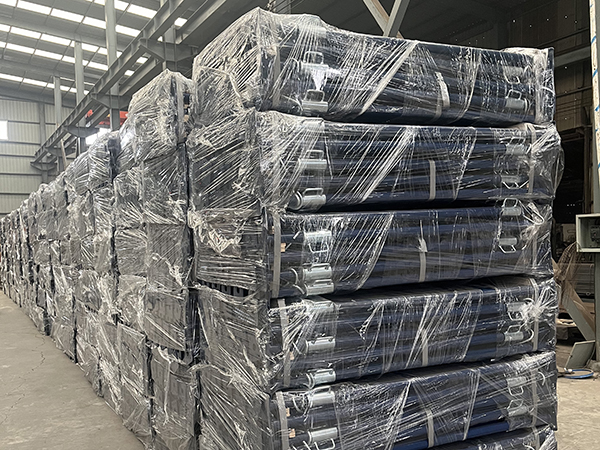
The reusable nature of steel support also simplifies logistics: one inventory serves multiple project sizes and configurations, reducing storage requirements and procurement complexity.
Schedule Certainty Through Certified Performance
Timber shoring performance varies with material condition, moisture content, and the skill of the person who assembled it. This variability introduces uncertainty into striking decisions—concrete may need to cure longer than planned if shoring performance cannot be verified, directly impacting follow-on trades and overall schedule.
Steel support eliminates this uncertainty. Every prop carries a marked Safe Working Load (SWL) rating certified through proof testing to BS EN 1065. Structural engineers can calculate stripping times with confidence, knowing that the shoring capacity is a known, documented quantity—not a judgment call based on visual inspection of timber members.
Contractors report that the predictability of steel support performance reduces the frequency of schedule-extending "wait for concrete" periods by approximately 30% compared to timber-intensive projects.
Labor Optimization and Skill Dependency
Quality timber shoring requires skilled carpenters who understand load distribution, cantilever mechanics, and proper wedging technique. In markets facing skilled labor shortages, this dependency creates bottlenecks and quality inconsistency.
Steel support systems reduce skill dependency significantly. The manufacturer-provided load tables and simple pin-and-collar mechanisms allow semi-skilled workers to install shoring that performs to specification. This enables contractors to deploy their skilled workforce on higher-value activities—reinforcement fixing, complex formwork, and concrete finishing—while less experienced crew handle the steel support installation.
Safety Efficiency Gains
Productivity is inseparable from safety. Unsafe conditions create delays, investigations, and rework. Steel support contributes to safety efficiency in several measurable ways:
Reduced manual handling of heavy timber sections (timber for heavy shoring can weigh 15–25 kg per linear metre).
No cutting operations on-site (eliminates sawdust, noise, and potential for finger injuries).
Certified load ratings enable accurate pre-calculation of shoring requirements, preventing overload scenarios.
Lighter, modular components reduce musculoskeletal injury rates during installation and strike.
HSE data indicates that sites using systematic steel support systems report 35–45% fewer musculoskeletal injuries related to formwork and shoring compared to timber-intensive operations.
Total Project Cost Impact
When evaluating steel support efficiency, procurement teams should look beyond unit purchase price to total project cost:
Labor savings: 100+ person-hours per floor saved on shoring installation and strike.
Reduced rework: 65–80% fewer rework hours due to dimensional accuracy.
Material waste: Near-zero timber waste from cut-to-length operations.
Schedule acceleration: 5–10% earlier slab striking enables faster follow-on trade access.
Equipment amortization: 300–500 reuse cycles spread acquisition cost across many projects.
FAQ: How Steel Support Improves Construction Efficiency
How much time can steel support save on a typical floor slab?
On a floor slab with 80 support points, using steel support instead of timber shoring saves approximately 100 person-hours of labor during installation and strike. For a multi-floor project, this compounds significantly—10 floors could save 1,000+ person-hours.
Do steel support systems require specialized training?
No. Steel support systems are designed for simplicity. Workers with basic construction experience can achieve specification-compliant installations after a 30-minute toolbox talk covering height adjustment, pin insertion, and load rating awareness. No specialized carpentry or engineering skills are required.
Can steel support be used for all slab types and heights?
Yes. Standard adjustable props cover heights from 1.0 m to 4.8 m through multiple size ranges. For higher loads or taller falsework, modular frame systems and tower solutions extend the range. A qualified falsework designer should specify the steel support configuration for complex or high-load applications.
What is the cost difference between steel support and timber shoring?
Steel support has a higher initial cost per unit but a far lower total cost per use. Over a project lifecycle, steel support typically reduces total shoring cost by 25–40% compared to timber, primarily through labor savings, reusability, and reduced rework.
Conclusion
Steel support improves construction efficiency through a combination of measurable factors: faster installation, precision adjustment, certified performance, reusability, and reduced skill dependency. The productivity gains—measured in hundreds of person-hours per project—directly translate to schedule acceleration and lower total project cost.
For B2B procurement and project management teams, the case for steel support is not primarily about the unit price of equipment. It is about the total cost of construction operations and the competitive advantage that schedule certainty and quality consistency provide. In an industry where margins are tight and schedules are critical, steel support is a proven efficiency investment.
References
British Standards Institution. (2018). BS EN 1065:2018 Adjustable Telescopic Steel Props—Product Specifications. BSI.
Goodman, R., & Emuze, F. (2017). "Productivity Comparison Between Timber and Steel Scaffolding Systems." Construction Innovation, 17(2), 191–209.
Health and Safety Executive. (2023). Guidance on Falsework and Shoring Safety. HSE Books.
American Concrete Institute. (2018). ACI 347-18: Guide to Formwork for Concrete. ACI.
Zhang, Y., & Sun, L. (2022). "Efficiency Analysis of Adjustable Steel Props in High-Rise Construction." Journal of Building Engineering, 49, 104012.