








The scaffolding industry has undergone a significant shift in platform decking material over the past two decades. While wooden scaffold boards served as the default for generations, steel plank has emerged as the preferred choice for professional scaffolding contractors, industrial maintenance companies, and construction firms committed to long-term safety and asset efficiency.
This article explains the specific reasons why steel plank has become the standard in modern scaffolding, examining performance data across load capacity, fire safety, durability, maintenance, and total cost of ownership.
Load Capacity and Structural Performance
Steel plank platforms consistently outperform wooden boards across every structural performance metric:
Uniformly Distributed Load (UDL): Standard steel plank (240 mm wide, 1.5 mm minimum gauge) supports UDL ratings of 200–270 kg per plank, comfortably exceeding the BS EN 12811 Service Class SC2 requirement of 2.0 kN/m². Wooden boards of equivalent width support 150–170 kg under the same conditions.
Deflection control: Under full design load, quality steel plank deflects approximately L/200–L/250, maintaining a flat, stable platform surface. Wooden boards deflect more significantly under equivalent loads, creating uneven walking surfaces that increase trip hazards.
Consistency: Steel is an engineered material with predictable, repeatable performance. Two steel plank units from the same batch will perform identically. Wooden boards vary with species, grain, moisture content, and defect presence.
Fire Resistance: A Critical Safety Differentiator
Fire safety is one of the most compelling arguments for steel plank over wooden platforms. Scaffolding frequently operates in environments where hot work (welding, cutting, grinding) is conducted at height. In these conditions, the fire performance of the platform material is a life-safety consideration:
Steel plank: Non-combustible. Steel does not ignite, burn, or contribute to fire spread. In the event of a fire below the scaffold, steel plank maintains structural integrity at temperatures up to 500–600°C (beyond which structural steel loses significant strength—though this scenario is rare in typical scaffolding fire exposure).
Wooden planks: Combustible. Dry wooden scaffold boards ignite readily and can contribute to fire propagation. Under UK fire safety regulations (BS 9991) and OSHA guidance, combustible materials used at height in hot work environments require additional risk assessment and mitigation measures.
In industrial maintenance, petrochemical facilities, and high-rise construction involving hot work, steel plank is increasingly specified as a condition of site access—not merely a preference.
Durability and Service Life
The contrast in service life between steel plank and wooden boards is stark:
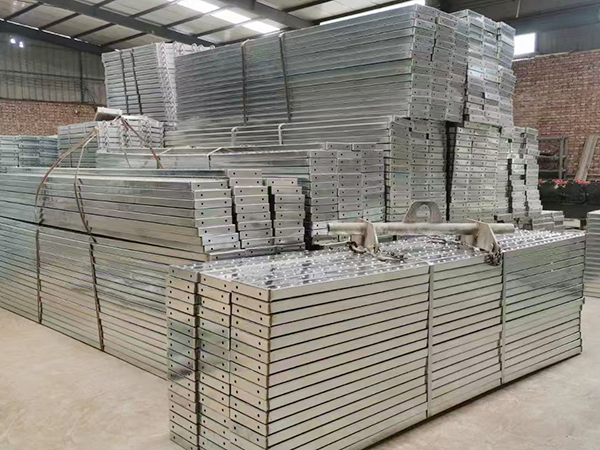
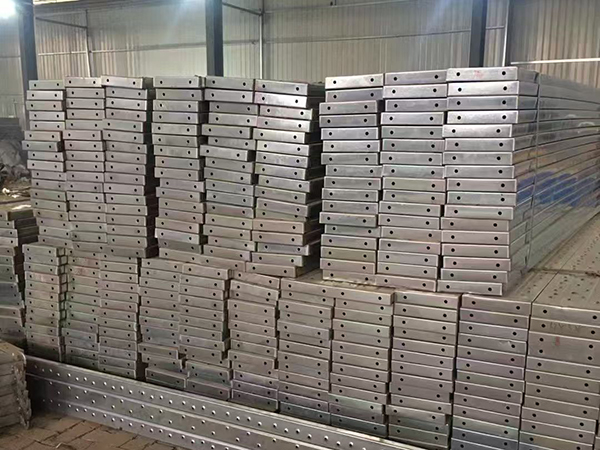
Steel plank: Hot-dip galvanized steel plank delivers 15–25 years of service life under normal atmospheric conditions. With proper maintenance (coating repair, inspection), service life extends to 25–30 years. Steel plank is immune to UV degradation, biological decay, and moisture-induced strength loss.
Wooden planks: Average service life of 3–7 years depending on storage conditions, exposure, and handling care. Wooden boards are susceptible to moisture absorption (causing swelling, warping, and weight gain), fungal decay, insect attack, and progressive strength loss from repeated wet-dry cycles.
Over a 20-year project assessment, a steel plank investment replaces 3–5 sets of wooden boards—an 80% reduction in material procurement volume.
Anti-Slip Surface Performance
Steel plank platforms incorporate factory-formed anti-slip surfaces that maintain their grip performance throughout the service life:
Diamond pattern pressed steel: The most common steel plank anti-slip surface. The raised diamond shapes channel water and contaminants away from the contact surface, maintaining traction in wet conditions. The pattern is integral to the steel and does not wear away as surface coatings would.
Perforated steel: Round or slotted perforations with raised edges provide excellent slip resistance. Water drains through the perforations, eliminating surface accumulation. Preferred in offshore, marine, and food processing environments.
Enhanced anti-slip coatings: For the most demanding wet or oily conditions, epoxy aggregate coatings applied to steel plank surfaces provide CoF (Coefficient of Friction) ratings of 0.6–0.8 even when contaminated—significantly exceeding the 0.4–0.5 ratings of weathered wooden surfaces.
Maintenance: Lower Cost and Simpler Protocols
Steel plank maintenance is simpler and less frequent than wooden board maintenance:
Inspection: Visual inspection of steel plank is straightforward—visible defects are immediately apparent. Wooden board inspection requires trained assessors to identify internal defects, moisture content, and incipient failures not visible on the surface.
Cleaning: Concrete and mortar deposits on steel plank are removed with a wire brush or low-pressure water. Wooden boards require drying time to prevent moisture entrapment that accelerates decay.
Coating repair: Minor coating damage on steel plank is repaired with zinc-rich paint in minutes. Wooden board damage is permanent—cracked, split, or decayed boards must be replaced.
Storage: Steel plank tolerates outdoor storage with minimal degradation. Wooden boards require covered, ventilated, flat storage to prevent warping and decay.
Environmental and Sustainability Considerations
Modern procurement increasingly weighs environmental impact:
Steel plank: Manufactured from 30–40% recycled steel scrap. Fully recyclable at end of life. The 15–25 year service life and high re-use rate (200–500 cycles) minimize cumulative resource consumption per year of service.
Wooden planks: Timber is a renewable resource, but scaffold boards often come from non-certified sources. The shorter service life means higher cumulative timber demand. Treated wooden boards present chemical disposal challenges at end of life.
For projects with environmental management system requirements (ISO 14001, BREEAM, LEED credits), steel plank generally offers a more favorable profile.
FAQ: Why Steel Plank Is Used in Modern Scaffolding
Can steel plank be used with all scaffolding system types?
Yes. Steel plank is compatible with all standard scaffolding systems including tube-and-fitting, ringlock, cuplock, kwikstage, and frame scaffolding. Standard widths (240 mm and 320 mm) and lengths (1,200–3,000 mm) are available to match standard bay dimensions across all systems.
What is the maximum span for steel plank without intermediate support?
For standard steel plank with 240 mm width and 1.5 mm gauge, the unsupported span between transoms should not exceed 1.5 m. For spans exceeding 1.5 m, specify heavy-duty steel plank with thicker gauge (2.0 mm) or intermediate support. Always verify against BS EN 12811 load class requirements for the specific application.
Does galvanized steel plank require recoating during its service life?
Rarely. Hot-dip galvanization to ISO 1461 (65+ µm) typically provides 15–25 years of corrosion protection without maintenance. Minor coating damage can be touched up with zinc-rich paint. Full recoating is typically unnecessary unless the plank has been subjected to unusually aggressive corrosive conditions (very high salinity, strong acids, or prolonged abrasion).
How does steel plank perform in extreme cold?
Steel plank is unaffected by cold temperatures—steel maintains its mechanical properties down to -20°C and below without embrittlement. This makes steel plank particularly suitable for winter construction, cold storage facilities, and cryogenic plant maintenance where wooden planks may become brittle or frozen to surfaces.
Conclusion
Steel plank has become the standard in modern scaffolding because it outperforms wooden boards on virtually every dimension that matters: structural performance, fire safety, durability, maintenance simplicity, and total cost of ownership. The initial cost premium is real but modest—and it is recovered within 2–3 years of regular use through lower replacement rates and reduced maintenance burden.
For procurement teams making long-term inventory decisions, steel plank represents the evidence-based choice. It is the material that the scaffolding industry has collectively moved toward because it is safer, more reliable, and more economical over the lifecycle of the asset.
References
British Standards Institution. (2019). BS EN 12811-1:2019 Temporary Works Equipment—Scaffolds—Performance Requirements and General Design. BSI.
Peng, J., et al. (2021). "Lifecycle Cost Analysis of Steel and Timber Scaffolding Decking Materials." Construction and Building Materials, 276, 122354.
American Society of Civil Engineers. (2021). ASCE 37: Design Loads on Structures During Construction. ASCE.
National Access and Scaffolding Confederation. (2022). SG4:22 Preventing Falls in Scaffolding. NASC.
International Organization for Standardization. (2019). ISO 1461:2019 Hot Dip Galvanized Coatings on Iron and Steel Articles. ISO.